Sunday, 3 July 2011

Notes on 'bricolage' from 'The Savage Mind' by Claude Lévi Strauss

Chapter One
The Science of the Concrete


still from video
In fact, the delimitation (determination of limits) of concepts is different in every language, and, as the author of the article ‘nom’ in the Encyclopédie correctly observed in the eighteenth century, the use of more or less abstract terms is a function not of greater or lesser intellectual capacity, but of differences in the interests – in their intensity and attention to detail – of particular social groups within the national society: ‘In an observatory a star is not simply a star but β of Capri- corn or γ of Centaur or ζ of the Great Bear, etc. In stables every horse has a proper name – Diamond, Sprite, Fiery, etc.’


still from video


To transform a weed into a cultivated plant, a wild beast into a domestic animal, to produce, in either of these, nutritious or technologically useful properties which were originally completely absent or could only be guessed at; to make stout, water-tight pottery out of clay which is fri- able and unstable, liable to pulverize or crack (which, however, is possible only if from a large number of or- ganic and inorganic materials, the one most suitable for refining it is selected, and also the appropriate fuel, the temperature and duration of firing and the effective degree of oxidation); to work out techniques, often long and com- plex, which permit cultivation without soil or alternatively without water; to change toxic roots or seeds into food- stuffs or again to use their poison for hunting, war or ritual – there is no doubt that all these achievements required a genuinely scientific attitude, sustained and watchful interest and a desire for knowledge for its own sake. For only a small proportion of observations and experiments (which must be assumed to have been primarily inspired by a de- sire for knowledge) could have yielded practical and im- mediately useful results. There is no need to dwell on the working of bronze and iron and of precious metals or even the simple working of copper ore by hammering which preceded metallurgy by several thousand years, and even at that stage they all demand a very high level of technical proficiency.

Neolithic, or early historical, man was therefore the heir of a long scientific tradition. However, had he, as well as all his predecessors, been inspired by exactly the same spirit as that of our own time, it would be impossible to understand how he could have come to a halt and how several thousand years of stagnation have intervened between the neolithic revolution and modern science like a level plain between ascents. There is only one solution to the paradox, namely, that there are two distinct modes of scientific thought. These are certainly not a function of different stages of development of the human mind but rather of two strategic levels at which nature is accessible to scientific enquiry: one roughly adapted to that of perception and the imagination: the other at a remove from it. It is as if the necessary connections which are the object of all science, neolithic or modern, could be arrived at by two different routes, one very close to, and the other more remote from, sensible intuition.


still from video


There still exists among ourselves an activity which on the technical plane gives us quite a good understanding of what a science we prefer to call ‘prior’ rather than ‘primitive’, could have been on the plane of speculation. This is what is commonly called ‘bricolage’ in French. In its old sense the verb ‘bricoler’ applied to ball games and billiards, to hunting, shooting and riding. It was however always used with reference to some extraneous movement: a ball rebounding, a dog straying or a horse swerving from its direct course to avoid an obstacle. And in our own time the ’bricoleur’ is still someone who works with his hands and uses devious means compared to those of a craftsman.The characteristic feature of mythical thought is that it expresses itself by means of a heterogeneous repertoire which, even if extensive, is nevertheless limited. It has to use this repertoire, however, whatever the task in hand because it has nothing else at its disposal. Mythical thought is therefore a kind of intellectual ‘bricolage’ – which explains the relation which can be perceived between the two.


* The ‘bricoleur’ has no precise equivalent in English. He is a man who undertakes odd jobs and is a Jack of all trades or a kind of professional do-it-yourself man, but, as the text makes clear, he is of a different standing from, for instance, the English ‘odd job man’ or handyman (trans. note).


still from video

The analogy is worth pursuing since it helps us to see the real relations between the two types of scientific knowledge we have distinguished. The ‘bricoleur’ is adept at performing a large number of diverse tasks; but, unlike the engineer, he does not subordinate each of them to the availability of raw materials and tools conceived and procured for the purpose of the project. His universe of instruments is closed and the rules of his game are always to make do with ‘whatever is at hand’, that is to say with a set of tools and materials which is always finite and is also heterogeneous because what it contains bears no relation to the current project, or indeed to any particular project, but is the contingent result of all the occasions there have been to renew or enrich the stock or to maintain it with the remains of previous constructions or destructions. The set of the ‘bricoleur’s’ means cannot therefore be defined in terms of a project (which would presuppose besides, that, as in the case of the engineer, there were, at least in theory, as many sets of tools and materials or ‘instrumental sets’, as there are different kinds of projects). It is to be defined only by its potential use or, putting this another way and in the language of the ‘bricoleur’ himself, because the elements are collected or retained on the principle that ‘they may always come in handy’. 

They each represent a set of actual and possible relations; they are ‘operators’ but they can be used for any operations of the same type.


still from video


Wednesday, 29 June 2011

Notes from "Teorema" by Pier Paolo Pasolini


We must try to invent new techniques, unrecognizable......which are unlike any previous method......to avoid childishness, ridicule......make our world unlike any other......where previous standards don't apply......which must be new, like the technique. Nobody must realize that the artist is worthless......that he's an abnormal, inferior being......who squirms and twists like a worm to survive. Nobody must ever catch him out as naive. Everything must be presented as perfect......based on unknown, unquestionable rules......like an madman, that's it. Pane after pane, because I can't correct anything......and nobody must notice. A sign painted on a pane......corrects, without soiling it......a sign painted earlier on another pane. But everyone must believe......that it isn't the trick of an untalented artist, impotent artist. Not at all. It must look like a sure decision......fearless, lofty and almost arrogant. Nobody must know that a sign succeeds by chance... is fragile. That as soon as a sign appears well made, by a miracle......it must be protected, looked after, as in a shrine. But nobody must realize......that the artist is a poor, trembling idiot, second-rate......living by chance and risk, in disgrace like a child......his life reduced to absurd melancholy......degraded by the feeling of something lost for ever.

Thursday, 23 June 2011

Guy Sherwin's 'Paper Landscape' / Karolina Raczynski's 'Skype Call'

Click to : Documentation of Guy Sherwin's 'Paper Landscape


Or watch Karolina Raczynski's piece 'Skype Call', inspired by Guy Sherwin's 'Paper Landscape' 
from the Royal College of Art 'Acoustic Images' showcase (Year 1)

Super 8 Simon

Footage shot in 2009

Polytechnic (Raven Row Gallery)

Notes from the BFI Review, the exhibition catalogue and others.

Yet a sort of personable humour is here in abundance. One of the best examples is John Adams’s Sensible Shoes (1983). It’s a love story as told by an amnesiac spectator. On the soundtrack, we hear a woman ad-libbing a narrative based on sequences of trashy daytime television, cop shows, and adverts for such wonderfully demodé brands as Interflora and Quantro. Our narrator is continuously distracted, and shuns the real world, as if entranced by the gloss and glamour of television itself.

Script inspired from crossword puzzle in 'Sensible Shoes' by John Adams.
(a claustrophobic and enclosed space)

Marc Camille Chaimowicz :
They flicker between the indexes of fine art and decorative arts, shifting our understanding of the space in which we experience them, which oscillates between the aesthetic, the domestic and the dramatic.


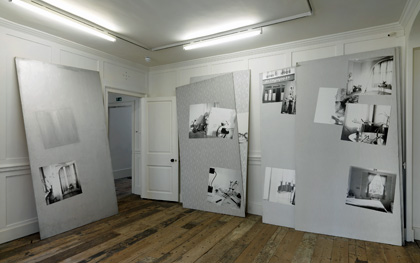
Other works here had a unashamed grace and beauty. Marc Camille Chamowicz’s dandyish installation Here and There (1978) is a series of boards featuring filmic images that could have come straight from a Louis Malle or Jean Eustache movie – a man broodily smoking in an elegantly bohemian-minimal apartment, snapshots of phone calls being made, typewriters abandoned.

Interchangeability : Catherine Elwes, Kensington Gore. fantasy and fiction.

Notes from my Blackberry

Anarchitecture group:
Square yourself. With who. Square yourself. Each side up. Spread Eagled down. Floor flushed and dead straight. Right angled and clean out, floored finally resting firmly lying low, flat broke and quite down here.

William Blake:

Everything is an attempt to be human

Frank Sinatra:
Cock your hats, angles and attitudes

Susan Hiller:
How does production relate to desire?
How does desire relate to representation?
How does representation relate to death?

Sonorous Desires

Text I wrote published in MS.USE Magazine


“In these moments of subtle pain, it becomes impossible for us, even in dreams, to be a lover or a hero, even to be happy. It is all empty, even the idea of its emptiness. it is all spoken in another language, incomprehensible to us, mere sounds of syllables that find no echo in our understanding. Life, the soul and the world are all hollow. All the gods die a death greater than death itself. Everything is emptier than the void. It is all chaos of nothing.”

Fernando Pessoa (The book of disquiet)


Meital Covo's Somniloquy (2009) is a sound-based piece that exists in multiple forms: as a film with just subtitles, an installation, a performance, and now as a series of images. It was edited from personal sleep talking recordings, collected during 40 nights in April and May 2009, at 41 Manchester Street, London.

In Kutlug Ataman's installation Twelve (2004), twelve people stand before the camera to talk about their previous lifetimes. In this case, language revels a history, refers to geography and ultimately constructs an identity. Even so, language collapses:

"When two different realities of two different life stories are combined in one identity, the syntax fails to work and the structure of language becomes insufficient. Ataman explains this impossibility by the fact that all languages are dependent on the logic of a single life. When this life is doubled or multiplied, the syntax and grammar become confusing and incapable of ensuring a communication."

(Emre Baykal ,http://www.tba21.org/program/current/92/artworks/660?category=current)

Susan Hiller sometimes uses the voice instead of (or as) the body. The physicality of sound is brought forward and placed in close proximity to the audience. She speaks, whispers or chants (Elan, Magic Lantern and Belshazzar’s Feast). She considers sound to be archaic, thus suggesting that language might not be just about communication. In The Last Silent Movie (2007), extinct and endangered languages are gathered, translated and presented on to a black screen; whilst the translation ensures communication, it also evokes a sense of loss.

Similar to Antonin Artaud’s body without organs [1], the voice in Meital Covo's work floats through the airwaves, boundless and disembodied; it is the exhibition of a voice detached from its proprietor. A voice with more severity than we might care to subscribe to. In a sense, a black well stares back at us.
In Somniloquy the voice in the dark reclaims the day it lived prior to being seduced into sleephood. The idea here is to consider this language that has no place in our culture. To pay attention. If we listen (or read) carefully, we fumble our way to chaos.

This language does not belong to sleephood anymore. The artist hijacks her own voice and we become witnesses to this injustice. In effect, we familiarize, with the tone and timbre of her voice and the intimacy of the room (is it a cinema? is it a bedroom?). The artist sets free the becoming of a body, to make a body out of a voice. Meanwhile what is experienced, is a recording surface, a site from which all flows come and go. Her voice is a sonorous desire to bring together the inside and outside. Even so, we need not trouble ourselves with interpretation, as it is the incapability of interpretation which makes this work be affective.


"Only those who are unable to think what they feel obey grammatical rules. Someone who knows how to express himself can use those rules as he pleases."

Fernando Pessoa (The book of disquiet)

------------------------------------------------------------------------
[1] To Have Done with the Judgement of God (Pour en finir avec le jugement de dieu), a radio play by Antonin Artaud (1947)

Canonical Grimaces: Franz Xaver Messerschmidt


Saturday, 18 June 2011

Invitation to reverie


"My friend, the great Italian cultural critic Enrico Ghezzi, has written about this very thing, Dadda remembered: the invitation to reverie that a visionary cinema can provide, the invitation to become unconscious. No joke."

Notes from "The painter of modern life" by Charles Baudelaire

Beauty is made up, on the one hand, of an element that is eternal and invariable, though to determine how much of it there is is extremely difficult, and, on the other, of a relative circumstantial element, which we may like to call, successively or at one and the same time, contemporaneity, fashion, morality, passion. Without this second element, which is like the amusing, teasing, appetite-whetting coating of the divine cake, the first element would be indigestible, tasteless, unadapted and inappropriate to human nature. I challenge anyone to find any sample whatsoever of beauty that does not contain these two elements.